
I am, really.
I'm just having a hard time recovering from finishing p2 in Wind Tunnel's fantasy game for April. You may have seen "RideBuyers" on the graphic during last week's WT broadcast. Yep, that's me. I'm around. And I'll be around more. I promise. Have a great race week-
Wednesday, April 29, 2009

Tuesday, March 31, 2009
Saturday, March 28, 2009
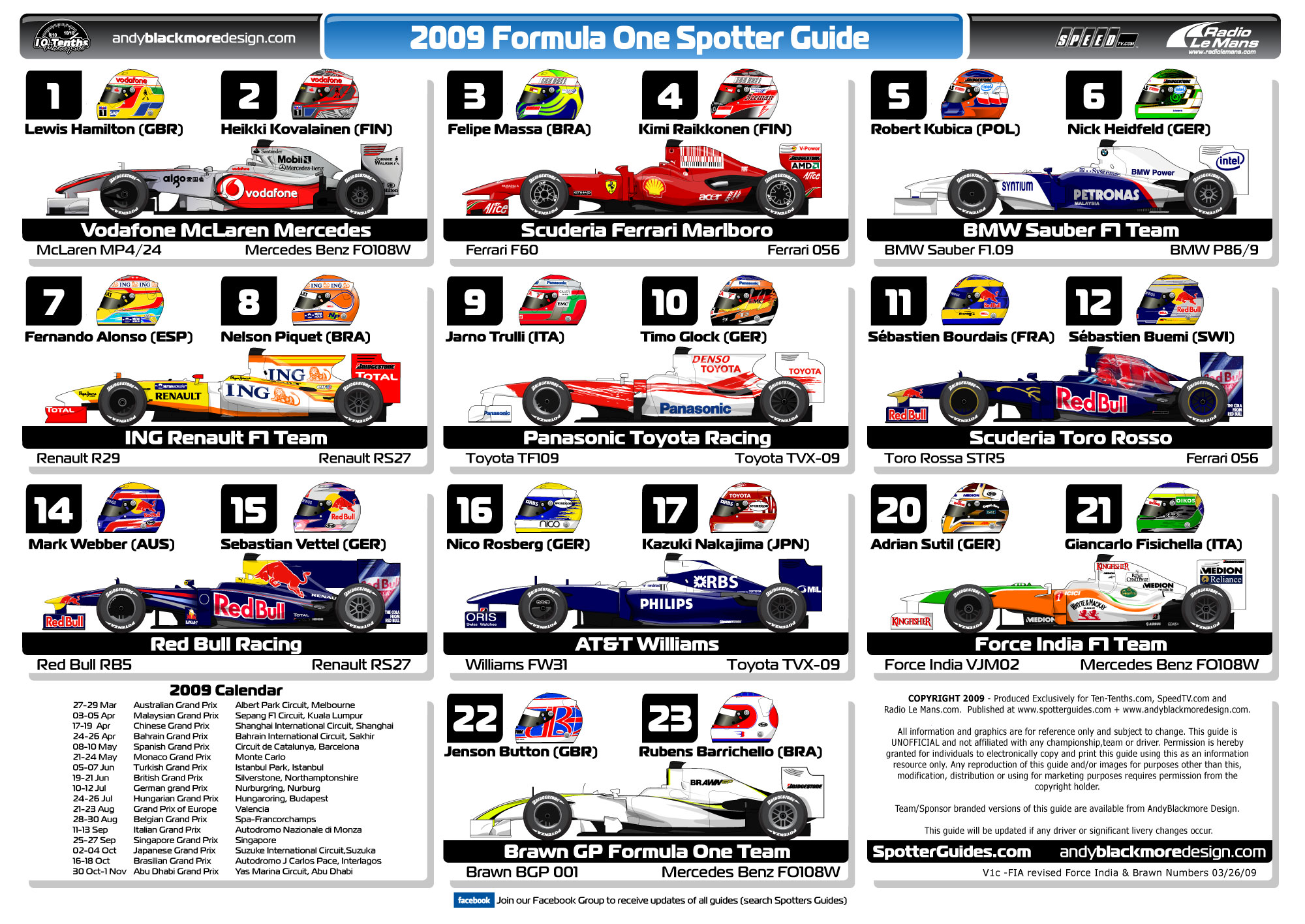
F1 spotter guide
Has the long off-season made you forget who the driver of the #2 Force India car is? You are certainly not alone. Check out this beautiful Andy Blackmore-designed spotter's guide for tonight's Australian GP. It's like porn, but with racing cars.
Oh, and it's Adrian Sutil, by the way.

Oh, and it's Adrian Sutil, by the way.
Tuesday, March 24, 2009
Random Sebring notes
-Alan McNish is an absolute monster. His spot in sporty car racing immortality was cemented well before Saturday's race, but his performance is still something to behold. In a word, devastating.
-Prototype racing will be lame for the rest of the season. Don't try to deny it, the cream of the sports racer crop will not competing in America this season. Acura will win both prototype classes in the ALMS this season (by default) which sucks, because their cars have way too much time and money invested in them to waste their possible awesomeness beating up on privateer machines.
-Speaking of privateers, the weak landscape of prototype racing this season creates two classes ripe for the picking for enterprising non-works outfits. Example: Watch the success of a team like Intersport Racing, contesting P1. With a few missteps or teething problems within the XM or Patron bunches, you could see some surprise results and contenders.
-I love when Justin Bell acts as roaming pitlane reporter for Speed. The definition of classic is when Bell, after asking an interviewee a question, becomes seemingly uninterested in their response, and moves the mic away mid-response. The next Edward R. Murrow has an accent.
-If P1 and P2 entries will be the weakest in recent memory, GT2 will be the strongest. Porsche v. Ferrari v. BMW v. Corvette (after Le Mans) v. GT40 v. Viper. That will be worth the price of admission to any event on the schedule.
- When the hell did Truth in 24 get made/air? I totally missed this and was not even aware of the film's existence until hour 4 of Saturday's race. It was on ESPN? Really? How about a little heads-up there WWL? If anyone knows when a re-air is happening please let me know!
-Prototype racing will be lame for the rest of the season. Don't try to deny it, the cream of the sports racer crop will not competing in America this season. Acura will win both prototype classes in the ALMS this season (by default) which sucks, because their cars have way too much time and money invested in them to waste their possible awesomeness beating up on privateer machines.
-Speaking of privateers, the weak landscape of prototype racing this season creates two classes ripe for the picking for enterprising non-works outfits. Example: Watch the success of a team like Intersport Racing, contesting P1. With a few missteps or teething problems within the XM or Patron bunches, you could see some surprise results and contenders.
-I love when Justin Bell acts as roaming pitlane reporter for Speed. The definition of classic is when Bell, after asking an interviewee a question, becomes seemingly uninterested in their response, and moves the mic away mid-response. The next Edward R. Murrow has an accent.
-If P1 and P2 entries will be the weakest in recent memory, GT2 will be the strongest. Porsche v. Ferrari v. BMW v. Corvette (after Le Mans) v. GT40 v. Viper. That will be worth the price of admission to any event on the schedule.
- When the hell did Truth in 24 get made/air? I totally missed this and was not even aware of the film's existence until hour 4 of Saturday's race. It was on ESPN? Really? How about a little heads-up there WWL? If anyone knows when a re-air is happening please let me know!
Wednesday, March 18, 2009

The great spec debate
Part of the fun of following motor racing is getting carte blanche to bitch and moan about a wide array of topics. Which guy’s faster? Who’s cheating? Which team is run by a bunch of morons? Which series is mismanaged? Which journalist is making shit up? And so forth. One of the hotter debates in recent memory is the spec car v. non-spec car argument. This gets the masses fired-up like Michael Phelps at a Kappa Kappa Gamma party. Like abortion and gay marriage, every fool has a spec car opinion that is -more often than not- based upon rumors, hearsay, something their priest told them when they were 12, or other make-believe trinkets of quasi-knowledge.
The fact of the matter is spec car racing has its pros and cons, just like every issue worth debating. There would be no debate, without positives and negatives to kick around, chew, and digest. So, here we go.
I’m about to make a glaring generality, so brace yourself. Most fans of our sport despise the idea of spec car racing. It’s treated like a bastard stepchild. One whose presence at family events is required, yet not embraced, because his “real” mom did meth and he can’t string together a coherent sentence because of the birth defects. Yeah, spec car racing is not that popular with fans.
It’s the concept of spec car racing that gives fans mental syphilis. The practice of spec car is something totally different.
The masses want to see the latest-and-greatest technology showcased. “Innovation” is buzzword tossed about circles of fans, mostly when speaking of the current batch of IndyCar standards. There is a yearning for new ideas and a “clean sheet of paper” approach when it comes to American open wheel racing. Vocal fans want to hear the words “…and a new track record!” reverberate off of the Tower Terrace at IMS. And fans want that record set with a something other than a Dallara chassis’ed, Honda powered, Firestone shod, Xtrac shifted, turnkey data acquisition system programmed, racing vehicle. Fans are pretty damn picky if you want to know the truth of it.
Of course, the totally valid argument against “innovation” and a “clean sheet” of anything are things like “money,” “resources,” and “desire.” All abstract concepts, themselves.
Sure, it would great if there were no restrictions on how to make your motor racing vehicle of choice traverse a circuit, but there needs to be takers to field such entries.
I would surmise that only a handful of teams would have the resources to build something “innovative.” Of those teams, someone would inevitably show up with something that looked like the Batmobile, goes 300-mph, cost $100 million to develop, and would kick everybody’s ass back from where they came. Teams’ would retreat, having sunk gobs of cash into a suddenly obsolete car, and this euphoric series would collapse faster than the Mets in late July. Don’t believe me? Take a look back at IMSA of the early 90’s or the original Can-Am. We know how this book ends. *Keep in mind; this represents the best-case scenario, as it features someone with enough cash to build a damn car. It’s a questionable assumption (at best) to say anyone could find the funding to build a “clean sheet” car today.
Motor racing is a sport that benefits greatly from grassroots participation. Of the fans that yearn for technological advancement to fuel motor racing, some might even participate in an entry-level form of racing. They autocross, go to track days, maybe even have a NASA or SCCA racer. Bet your bottom dollar these folks have an all too well understanding of cost containment in racing.
Spec Racer Ford, Spec Miata and Spec 944 are some of the most popular classes for amateur road racing in this country. The reasons are simple. A car can be built for a (relevantly) small investment, the racing is damn close, and the cars are pretty easy on replacement parts. In short, for a not-astronomically high investment, you get to go racing and car development is limited so things like driver skill, race strategy and car prep make the difference. What’s wrong with that? On a grassroots level, nothing, and no one could possibly argue otherwise.
But, what’s wrong with that on a professional level? I say nothing.
There just needs to be a happy medium between spec car affordability and the ingenuity that our sport was founded upon.
That brings us back to the debate waged by IndyCar fans on message boards, and bar stools across the country. Spec car v. non-spec car. Who is right? Both guys, of course.
Whenever the IndyCar redesign actually happens (2011 or beyond), we need a formula that gives fans and nerdy engineering types the possibility for innovation, development and all that other jazz. (Granted the chassis will still come from a single source, But we’ll overlook that.)
Conversely, the league needs to insure that there is an abundant supply of turnkey cars that a high-level Atlantic or Grand Am team could purchase and run back-to-mid pack right out of the truck. Oh, and for a reasonable price. Sound tough to do? You bet. But creating and nurturing an environment of innovation, while insuring a fresh supply of young teams can complete are two needed facets of competition to get this thing relevant again.
The fact of the matter is spec car racing has its pros and cons, just like every issue worth debating. There would be no debate, without positives and negatives to kick around, chew, and digest. So, here we go.
I’m about to make a glaring generality, so brace yourself. Most fans of our sport despise the idea of spec car racing. It’s treated like a bastard stepchild. One whose presence at family events is required, yet not embraced, because his “real” mom did meth and he can’t string together a coherent sentence because of the birth defects. Yeah, spec car racing is not that popular with fans.
It’s the concept of spec car racing that gives fans mental syphilis. The practice of spec car is something totally different.
The masses want to see the latest-and-greatest technology showcased. “Innovation” is buzzword tossed about circles of fans, mostly when speaking of the current batch of IndyCar standards. There is a yearning for new ideas and a “clean sheet of paper” approach when it comes to American open wheel racing. Vocal fans want to hear the words “…and a new track record!” reverberate off of the Tower Terrace at IMS. And fans want that record set with a something other than a Dallara chassis’ed, Honda powered, Firestone shod, Xtrac shifted, turnkey data acquisition system programmed, racing vehicle. Fans are pretty damn picky if you want to know the truth of it.
Of course, the totally valid argument against “innovation” and a “clean sheet” of anything are things like “money,” “resources,” and “desire.” All abstract concepts, themselves.
Sure, it would great if there were no restrictions on how to make your motor racing vehicle of choice traverse a circuit, but there needs to be takers to field such entries.
I would surmise that only a handful of teams would have the resources to build something “innovative.” Of those teams, someone would inevitably show up with something that looked like the Batmobile, goes 300-mph, cost $100 million to develop, and would kick everybody’s ass back from where they came. Teams’ would retreat, having sunk gobs of cash into a suddenly obsolete car, and this euphoric series would collapse faster than the Mets in late July. Don’t believe me? Take a look back at IMSA of the early 90’s or the original Can-Am. We know how this book ends. *Keep in mind; this represents the best-case scenario, as it features someone with enough cash to build a damn car. It’s a questionable assumption (at best) to say anyone could find the funding to build a “clean sheet” car today.
Motor racing is a sport that benefits greatly from grassroots participation. Of the fans that yearn for technological advancement to fuel motor racing, some might even participate in an entry-level form of racing. They autocross, go to track days, maybe even have a NASA or SCCA racer. Bet your bottom dollar these folks have an all too well understanding of cost containment in racing.
Spec Racer Ford, Spec Miata and Spec 944 are some of the most popular classes for amateur road racing in this country. The reasons are simple. A car can be built for a (relevantly) small investment, the racing is damn close, and the cars are pretty easy on replacement parts. In short, for a not-astronomically high investment, you get to go racing and car development is limited so things like driver skill, race strategy and car prep make the difference. What’s wrong with that? On a grassroots level, nothing, and no one could possibly argue otherwise.
But, what’s wrong with that on a professional level? I say nothing.
There just needs to be a happy medium between spec car affordability and the ingenuity that our sport was founded upon.
That brings us back to the debate waged by IndyCar fans on message boards, and bar stools across the country. Spec car v. non-spec car. Who is right? Both guys, of course.
Whenever the IndyCar redesign actually happens (2011 or beyond), we need a formula that gives fans and nerdy engineering types the possibility for innovation, development and all that other jazz. (Granted the chassis will still come from a single source, But we’ll overlook that.)
Conversely, the league needs to insure that there is an abundant supply of turnkey cars that a high-level Atlantic or Grand Am team could purchase and run back-to-mid pack right out of the truck. Oh, and for a reasonable price. Sound tough to do? You bet. But creating and nurturing an environment of innovation, while insuring a fresh supply of young teams can complete are two needed facets of competition to get this thing relevant again.
Thursday, March 12, 2009
Get local, get fired
I used to work in radio. It’s an odd business. The people who work in radio are odd. Radio stations are odd. People who listen to the radio are odd. The entire industry, from the highest-level exec, to the lowest of board-ops, has become resigned that they are working in a dying industry. It’s a slow bleed, but it’s definitely a kill, not a wound. (Respects to Daniel Day Lewis in Gangs.) People in radio know their days are numbered, but nobody talks about D-Day. The boat is sinking and the band continues playing as they disappear into icy water. Everybody knows, but nobody acts. Odd.
The radio business was in the tank well before the economy collapsed. This is not like the bank industry, where imminent demise is a relevantly new development. Radio has been in the ICU for years.
It’s the contradictions that make the radio business really weird (and by weird, I mean insolvent).
One such inconsistency is the local-versus-national debate waged numerous times over the course of my sterling yet brief radio career.
Program Directors want to have as much local programming as possible. The idea being that regionally-centric programming will be a greater draw than nationally based shows that may not be relevant to a local audience. That makes sense. Right?
The inconsistency comes when the same PD fires local show hosts to bring in cheap syndicated programming because the station can’t afford to pay a talker 12 bucks an hour. The same story has been played out in AM stations across the country, no matter if the station is a Clear Channel flagship or a 1000-watt station in Bumblefuck, Nowhere.
This drawn-out story and scenario got me thinking about an idea I’ve had for a while and previously published on a now-defunct motor racing interweb site.
In a nutshell, the plan calls for a full time single-car IRL team with a revolving door of local drivers to contest each event. For example, Memo Gidley would be in the car for Sonoma, Clint Field at Mid-Ohio and so forth. Local one-off sponsorships would be sold and the league foots any remaining cost. All crew members, engineers, marketing types and other staff would be up-and-comers, guys and gals with little or no experience in the sport. A few experienced guys (I hear Derrick Walker is free, hint, hint) would mentor the young whippersnappers to make sure everything is safe and done in proper manner. It’s the motor racing equivalent of local programming.
It seems like a no-brainer. Local drivers and sponsorships attract more local fans. Everybody is a winner! Of course, at least now, it’s almost impossible to sell anything, so the financing could be an issue. But, if the league would jump on this plan, and really devote some money and manpower (in terms of some bright young salespeople), this could be a reality. If executed properly, the investment return would be quick.
Alas, someone in the sport has to play the role of radio Program Director (aka the Kill Joy). Is it Tony George? Is it Brian Barnhart? Is it the individual team owners? Yes. Probably. And yes. Local programming has long been cut, and fields are filled with drivers of little relevance to the average fan. Hopefully the IndyCar Series is not subject to the same fate –obscurity, demise, death, and destruction- as radio.
The radio business was in the tank well before the economy collapsed. This is not like the bank industry, where imminent demise is a relevantly new development. Radio has been in the ICU for years.
It’s the contradictions that make the radio business really weird (and by weird, I mean insolvent).
One such inconsistency is the local-versus-national debate waged numerous times over the course of my sterling yet brief radio career.
Program Directors want to have as much local programming as possible. The idea being that regionally-centric programming will be a greater draw than nationally based shows that may not be relevant to a local audience. That makes sense. Right?
The inconsistency comes when the same PD fires local show hosts to bring in cheap syndicated programming because the station can’t afford to pay a talker 12 bucks an hour. The same story has been played out in AM stations across the country, no matter if the station is a Clear Channel flagship or a 1000-watt station in Bumblefuck, Nowhere.
This drawn-out story and scenario got me thinking about an idea I’ve had for a while and previously published on a now-defunct motor racing interweb site.
In a nutshell, the plan calls for a full time single-car IRL team with a revolving door of local drivers to contest each event. For example, Memo Gidley would be in the car for Sonoma, Clint Field at Mid-Ohio and so forth. Local one-off sponsorships would be sold and the league foots any remaining cost. All crew members, engineers, marketing types and other staff would be up-and-comers, guys and gals with little or no experience in the sport. A few experienced guys (I hear Derrick Walker is free, hint, hint) would mentor the young whippersnappers to make sure everything is safe and done in proper manner. It’s the motor racing equivalent of local programming.
It seems like a no-brainer. Local drivers and sponsorships attract more local fans. Everybody is a winner! Of course, at least now, it’s almost impossible to sell anything, so the financing could be an issue. But, if the league would jump on this plan, and really devote some money and manpower (in terms of some bright young salespeople), this could be a reality. If executed properly, the investment return would be quick.
Alas, someone in the sport has to play the role of radio Program Director (aka the Kill Joy). Is it Tony George? Is it Brian Barnhart? Is it the individual team owners? Yes. Probably. And yes. Local programming has long been cut, and fields are filled with drivers of little relevance to the average fan. Hopefully the IndyCar Series is not subject to the same fate –obscurity, demise, death, and destruction- as radio.
Subscribe to:
Posts (Atom)


